
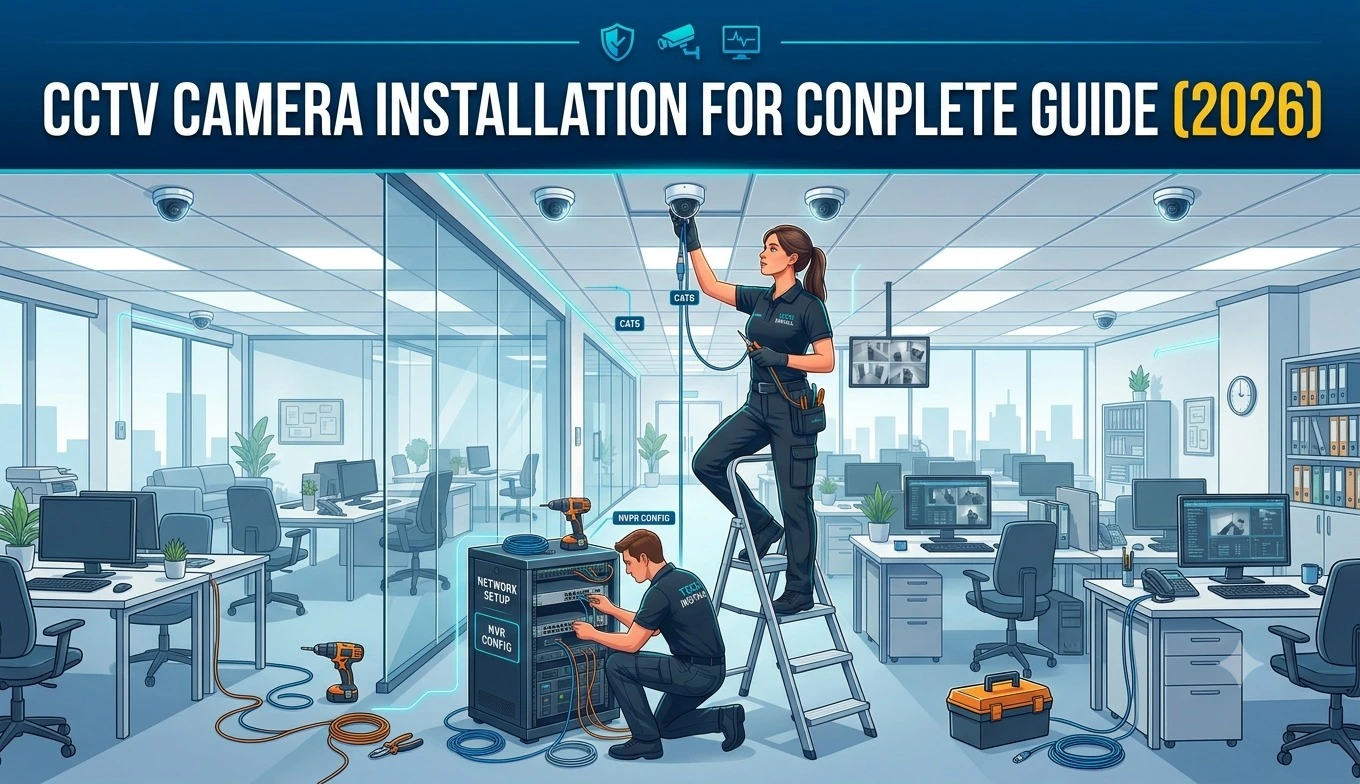
Setting up CCTV cameras in an office requires more than simply mounting cameras on walls. A successful installation involves preparing the office, selecting suitable locations, connecting the equipment, configuring recording and testing the complete system.
The setup process may vary depending on whether you use a DVR-based CCTV system, an NVR with IP cameras or another compatible surveillance solution.
This guide explains the basic step-by-step process of setting up CCTV cameras in an office.
- Prepare Your Office for CCTV Installation
- Choose the Final Camera Locations
- Prepare the CCTV Equipment
- Mount the CCTV Cameras
- Connect Cameras and Equipment
- Set Up the DVR or NVR
- Configure Recording Settings
- Set Up Remote Viewing
- Test the Complete CCTV System
- Create a Basic System Handover Checklist
- When to Use Professional Installation
- Frequently Asked Questions
- Final Thoughts
Step 1: Prepare Your Office for CCTV Installation
Before installing any cameras, prepare the office and confirm the planned CCTV locations.
Check:
- Available power connections
- Suitable cable routes
- Locations for the DVR or NVR
- Network availability, where required
- Monitor or display location
- Areas where cameras can be securely mounted
Keep the recording equipment in a suitable location where it can be safely accessed for maintenance.
Step 2: Choose the Final Camera Locations
Before mounting the cameras, confirm that each location provides useful coverage of the intended office area.
Common office CCTV locations include:
- Main entrance
- Reception area
- Important corridors
- Restricted access points
- Storage areas
- Equipment rooms
- Parking or outdoor access points, where required
Check for walls, partitions, furniture or lighting conditions that could block the camera view.
For help deciding how many cameras may be required, read our guide to estimating how many CCTV cameras your office needs.
Step 3: Prepare the CCTV Equipment
Before starting the installation, check that all required equipment is available and compatible.
A typical office CCTV setup may include:
- CCTV cameras
- DVR or NVR
- Surveillance hard drive
- Suitable camera cables
- Power supply equipment
- Network equipment where required
- Mounting screws and brackets
- Monitor for system setup
The exact equipment depends on the type of CCTV system being installed.
Step 4: Mount the CCTV Cameras
Mark the mounting points and securely install the camera brackets.
When mounting cameras:
- Use suitable screws and mounting hardware
- Make sure the mounting surface is secure
- Position the camera toward the intended coverage area
- Leave enough access for cable connections
- Protect outdoor installations appropriately
Do not finalise the camera angle until you can check the live video feed.
Step 5: Connect the Cameras and Equipment
The connection process depends on the CCTV technology being used.
DVR-Based CCTV Systems
Compatible cameras are connected to the DVR using the required cabling and power connections.
NVR and IP Camera Systems
IP cameras connect through a compatible network infrastructure. Some systems use PoE technology to provide network connectivity and power through compatible Ethernet equipment.
Keep all cables organised and protected to reduce the risk of accidental damage.
For more information about recording systems, read our DVR vs NVR comparison guide.
Step 6: Set Up the DVR or NVR
After connecting the cameras, set up the recording device.
Basic setup usually includes:
- Connecting a monitor
- Checking the camera feeds
- Setting the correct date and time
- Naming camera channels
- Checking storage availability
- Creating secure administrator credentials
Confirm that every connected camera is displaying correctly before continuing.
Step 7: Configure Recording Settings
Once the cameras are working correctly, configure how the system records footage.
Depending on the system, available options may include:
- Continuous recording
- Scheduled recording
- Motion-based recording
- Event-based recording
Also review storage settings to make sure the recording system meets your expected footage retention requirements.
Step 8: Set Up Remote Viewing
Many modern CCTV systems allow authorised users to access live or recorded footage remotely.
Use the official application or software recommended for your specific CCTV system and follow the manufacturer's configuration instructions.
Important security practices include:
- Use strong passwords
- Do not share administrator credentials unnecessarily
- Remove access for users who no longer require it
- Keep supported software updated
Step 9: Test the Complete CCTV System
Before considering the office CCTV setup complete, test every important function.
- Live video from every camera
- Camera viewing angles
- Image quality
- Night-time performance where applicable
- Recording and playback
- Motion or event detection settings
- Remote viewing access
Walk through the office and check whether important areas are clearly visible.
If you identify uncovered areas, adjust the camera angle or review whether additional coverage is required.
Step 10: Create a Basic CCTV System Handover Checklist
Once the system is working, make sure the responsible person understands the basic operation of the CCTV system.
The handover checklist should include:
- How to view live footage
- How to search and play recorded footage
- How to check camera status
- Who has authorised access
- Where important system information is stored
- How to contact the installer or support provider
Keeping this information organised can make future maintenance and troubleshooting easier.
When Should You Use Professional CCTV Installation?
Small and simple CCTV systems may be easier to set up. However, professional installation can be useful for offices with more complex requirements.
Consider professional installation when:
- The office has multiple floors
- Multiple cameras are required
- Long cable routes are needed
- Indoor and outdoor cameras are being installed
- Network configuration is required
- You need professional camera positioning
For complete office surveillance planning, you can explore our CCTV installation services in Hyderabad.
Frequently Asked Questions
Final Thoughts
Setting up CCTV cameras in an office involves careful preparation, correct installation, reliable equipment connections and proper system configuration.
After installation, always test the cameras, recording functions and remote viewing features before relying on the system for daily security monitoring.
If you are still planning your office CCTV coverage, read our CCTV Installation Planning Guide.
To estimate the number of cameras required for your office, read our office CCTV camera count guide.
