
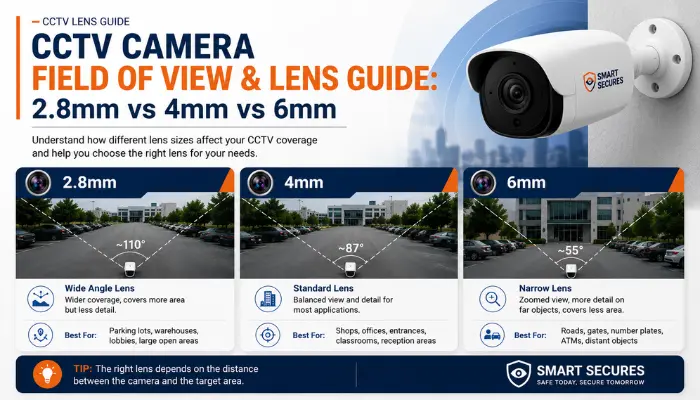
Picking the wrong lens is one of the most common CCTV mistakes. A camera with the wrong lens either misses the area you care about, or it covers too much ground to identify a face clearly. The lens size measured in millimetres (mm) decides both of these things.
This guide breaks down the three most common CCTV lens sizes 2.8mm, 4mm, and 6mm so you can match the right lens to the right space, without guesswork.
- What Is "Field of View" in CCTV, and Why Does It Matter?
- 2.8mm Lens: Wide-Angle Coverage for Close Range
- 4mm Lens: The Balanced, All-Purpose Choice
- 6mm Lens: Narrow View, Long-Range Detail
- Distance vs. Identification: What You Can Actually See
- Fixed Lens vs Varifocal Lens
- How to Choose the Right Lens for Your Space
- Common Mistakes to Avoid
- FAQs
- Final Thoughts
| Lens Size | Field of View (Horizontal) | Ideal Distance | Best For |
|---|---|---|---|
| 2.8mm | ~95°-110° (wide) | 3–8 metres | Shops, driveways, garages, small rooms, wide entrances |
| 4mm | ~80°-90° (standard) | 8–15 metres | Front doors, hallways, mid-size yards, reception areas |
| 6mm | ~50°-55° (narrow/zoom) | 15-25 metres | Gates, parking lots, long driveways, face recognition at distance |
Rule of thumb: the smaller the mm number, the wider the view and the shorter the effective identification distance. Bigger mm means a narrower, more zoomed-in view that reaches farther.
What Is "Field of View" in CCTV, and Why Does It Matter?
Field of view (FOV) is the width of the area a camera can see, expressed in degrees. It is controlled by the lens focal length the mm number printed on the camera spec sheet.
A short focal length (like 2.8mm) bends light more, so the sensor captures a wider scene. A longer focal length (like 6mm) narrows that view, but each object in the frame appears larger and more detailed.
This trade-off is the whole game in CCTV lens selection:
Wider FOV = more area covered, but people and faces look smaller and less detailed as distance increases.
Narrower FOV = less area covered, but people and faces stay clear and identifiable much farther away.
There is no single "best" lens only the right lens for the space you are covering.
2.8mm Lens: Wide-Angle Coverage for Close Range
A 2.8mm lens is the most common choice for CCTV cameras sold in India today, and for good reason.
Typical field of view: 95° to 110° horizontal, depending on the sensor.
What it is good at:
- Covering an entire room, shop floor, or small yard from one camera
- Watching a driveway, garage, or gate from a short distance
- Reducing the number of cameras needed for wide, open spaces
Where it falls short: Faces and number plates become hard to identify once a person is more than 6-8 metres from the lens. The wide angle also stretches the edges of the image slightly (a mild fisheye effect), which is normal and not a defect.
Best used for: small to mid-size homes, retail counters, single rooms, and compact driveways. This is the default lens on most dome cameras vs bullet cameras sold for residential use.
4mm Lens: The Balanced, All-Purpose Choice
A 4mm lens sits between wide coverage and long-range clarity, which is why installers often call it the "safe default" for general-purpose monitoring.
Typical field of view: 80 to 90 degrees horizontal.
What it is good at:
- Watching a front door or main entrance with enough width to catch approaching visitors
- Covering mid-size yards, corridors, and reception areas
- Identifying faces clearly up to roughly 10-12 metres away
Where it falls short: It not cover as much width as a 2.8mm lens, so very wide spaces may need an extra camera or two to avoid blind spots.
Best used for: entrances, office reception areas, hallways, and mid-size outdoor spaces where you need a balance of coverage and clarity. If you are setting up a workspace, this focal length pairs well with the placements covered in our office CCTV camera type guide.
6mm Lens: Narrow View, Long-Range Detail
A 6mm lens trades width for reach. It is built for situations where identifying a face, vehicle, or number plate at distance matters more than covering a wide area.
Typical field of view: 50 to 55 degrees horizontal.
What it is good at:
- Monitoring gates, boundary walls, and long driveways
- Reading number plates in parking lots
- Zooming in on a specific chokepoint, like a single entry lane
Where it falls short: The narrow angle means it misses everything outside its cone of view. A 6mm camera watching a gate will not see what is happening a few metres to either side.
Best used for: compound gates, factory entry points, long driveways, and parking areas where distance matters more than width. These setups often work best when combined with wider lenses elsewhere on the property see our guide on choosing the best outdoor CCTV camera locations for a full-property layout approach.
Distance vs. Identification: What You Can Actually See
Field of view alone does not tell the whole story. What matters practically is whether you can identify a face or plate at a given distance not just whether the camera "sees" it. Security professionals commonly use these general benchmarks (actual results vary by camera resolution and lighting):
| Purpose | Approx. Distance Needed |
|---|---|
| Detect that a person is present | Up to 2-3x the "identification" distance |
| Recognise a familiar face | 8-12 metres with a 4mm lens |
| Identify an unfamiliar face clearly | 4-6 metres with a 2.8mm lens, 10-15 metres with a 6mm lens |
| Read a number plate | Under 10 metres, ideally with a 6mm or longer lens |
Higher resolution (4MP, 5MP, or 4K) stretches these distances further, since more pixels fall on the same object even from farther away. If distance is a priority, pairing a 6mm lens with a higher-resolution sensor gives noticeably better results than relying on the lens alone.
Fixed Lens vs Varifocal Lens
Most 2.8mm, 4mm, and 6mm cameras use a fixed lens - the focal length is set at the factory and cannot be changed. This keeps the camera affordable and simple to install.
A varifocal lens camera lets you manually (or motor-zoom) adjust the focal length within a range, such as 2.8mm-12mm, after installation. This is useful when:
- You are unsure of the exact distance during planning
- One camera needs to cover a space that changes seasonally (like foliage growth near a gate)
- You want to fine-tune the angle after mounting, without swapping the camera
Varifocal cameras cost more but remove the guesswork a worthwhile trade-off for tricky angles or larger commercial properties.
How to Choose the Right Lens for Your Space
Match the lens to the job using this quick checklist:
- Measure the distance from the planned camera mounting point to the farthest area you need to monitor clearly.
- Under 8 metres and wide area -> go with 2.8mm.
- 8 to 15 metres, balanced coverage -> go with 4mm.
- 15 to 25 metres, narrow chokepoint -> go with 6mm.
- Unsure, or the space is irregular -> choose a varifocal lens camera.
- Multiple zones from one mounting point -> use two cameras with different lens sizes rather than forcing one lens to do both jobs.
If you are planning a full system rather than a single camera, our CCTV installation cost breaks down how camera count and lens choice affect your total budget.
Common Mistakes to Avoid
- Using only wide-angle lenses everywhere. A 2.8mm camera at the gate might show you a car arrived, but never let you read its number plate.
- Using only narrow lenses indoors. A 6mm lens in a small room leaves most of the space uncovered.
- Ignoring mounting height. A lens with the right FOV mounted too high or too low still creates blind spots. This is a common gap in DIY setups, which is why professional CCTV installation services always start with a site survey before deciding camera height and angle.
- Assuming resolution fixes a bad lens choice. A higher megapixel count improves detail, but it cannot widen a narrow lens or narrow a wide one.
Frequently Asked Questions
Final Thoughts
The right CCTV lens comes down to one question: do you need to see more, or see farther? 2.8mm gives you width, 4mm gives you balance, and 6mm gives you reach. Most properties end up using a mix of all three, placed according to what each specific area actually needs.
If you would rather have this assessed on-site than guess from a spec sheet, Smart Secures offers a free CCTV site visit across Hyderabad, where our certified technicians recommend the right lens and camera type for every corner of your property. Explore our full CCTV installation guide to plan your next steps.
