
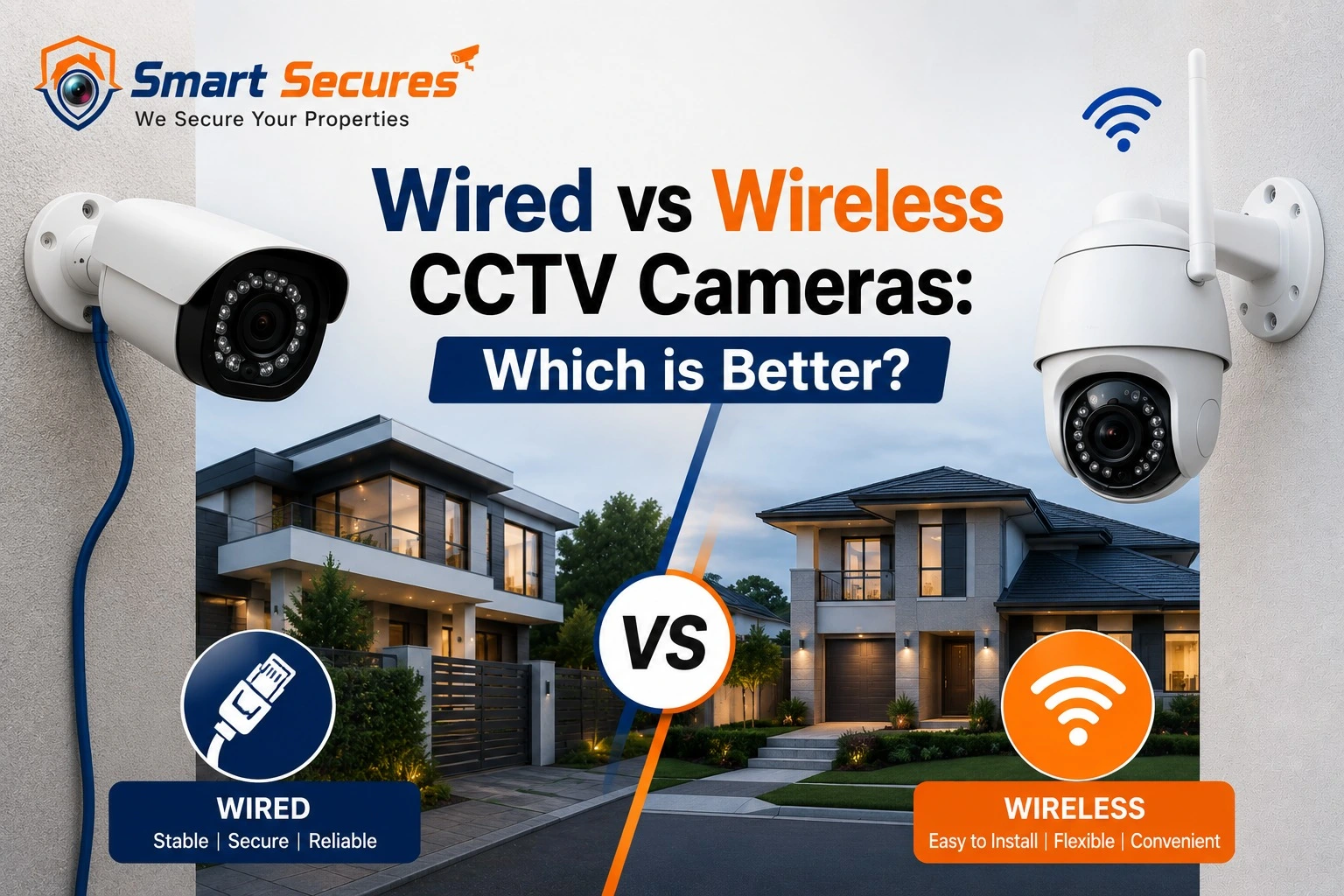
When planning CCTV installation services, one of the first decisions you face is simple — wired or wireless?
Both types record clear video. Both can send footage to your phone. But they work very differently. The right choice depends on your property, your budget, and how long you plan to use the system.
This guide breaks down everything you need to know about wired vs wireless CCTV cameras — so you can make a confident decision.
What Are Wired CCTV Cameras?
Wired CCTV cameras use physical cables to connect each camera to a recorder. The recorder is either a DVR (for HD cameras) or an NVR (for IP cameras).
Cables carry both video and power. Most modern wired systems use PoE (Power over Ethernet) cables — one cable handles everything. This makes installation cleaner and more reliable.
Wired cameras are always connected. They record continuously without interruption. There are no batteries to charge and no Wi-Fi signal to worry about.
Wired CCTV systems support several camera types. The most common ones used in homes and businesses are:
HD CCTV Cameras — HD CCTV Cameras in Hyderabad are best for homes and small offices needing clear footage on a budget. They use coaxial cables and connect to a DVR.
IP CCTV Cameras — ideal for offices, commercial properties, and large spaces. They deliver high-resolution video and support remote viewing.
PTZ CCTV Cameras — perfect for warehouses, factories, and large outdoor areas. They can pan, tilt, and zoom to cover wide spaces with fewer cameras.
Dome Cameras — widely used indoors for offices, reception areas, and corridors. Their compact design blends neatly into ceilings.
Bullet Cameras — ideal for main gates, driveways, and outdoor perimeter security. They are weatherproof and built for long-range monitoring.
What Are Wireless CCTV Cameras?
Wireless CCTV cameras send video over your Wi-Fi network. They do not need cables running from the camera to a recorder.
Most wireless cameras are battery-powered or solar-powered. Some connect to a wireless NVR. Others upload footage directly to the cloud.
Wireless cameras are easy to install. You can mount them almost anywhere with no drilling or cable routing required.
Wireless CCTV systems use cameras that connect through Wi-Fi or mobile networks. The most popular wireless options are:
WiFi CCTV Cameras — WiFi CCTV Cameras in Hyderabad are great for homes, rented flats, and small offices where cable routing is not possible. They connect through your home Wi-Fi network.
SIM-Based 4G CCTV Cameras — ideal for school buses, remote locations, and areas with no Wi-Fi or fixed internet connection. They use a mobile SIM card to transmit footage.
Solar CCTV Cameras — perfect for farmhouses, remote gates, and outdoor areas with no power supply. They run entirely on solar energy with no electricity bills.
Wired vs Wireless CCTV Cameras — Key Differences
1. Installation
Wired:CCTV Camera Installation requires drilling, cable routing through walls, and connecting cameras to a DVR or NVR. It takes more time and usually requires professional help.
Wireless: Installation is simple. Mount the camera, connect it to Wi-Fi, and set up the app. Most people do it themselves in under an hour.
Winner: Wireless — for ease of installation.
2. Reliability
Wired: Wired cameras are extremely reliable. They do not depend on Wi-Fi signal strength. Video quality stays consistent 24/7 regardless of network traffic or interference.
Wireless: Wireless cameras depend on your Wi-Fi. Weak signal, network congestion, or interference from other devices can cause dropped footage or lag.
Winner: Wired — for consistent, uninterrupted recording.
3. Video Quality
Wired: Wired systems support Full HD, 2MP, 4MP, and 4K resolution without any bandwidth limitations. The cable delivers a stable, high-quality feed at all times.
Wireless: Wireless cameras also support HD and 4K. However, video quality can drop if the Wi-Fi signal is weak or if multiple cameras are streaming simultaneously.
Winner: Wired — for consistently sharp footage.
4. Power Source
Wired: Wired cameras get power through PoE cables or a direct power adapter. They are always on. No charging or battery replacement needed.
Wireless: Most wireless cameras run on rechargeable batteries. Some use solar panels. Batteries need recharging every 1 to 3 months depending on usage.
Winner: Wired — for zero maintenance power.
5. Security Against Hacking
Wired: Wired systems run on private cables — not the internet. They are extremely difficult to hack remotely. Your footage stays on your local hard drive.
Wireless: Wireless cameras connect to the internet. If your Wi-Fi password is weak or your network is unsecured, cameras can be vulnerable to hacking.
Winner: Wired — for cybersecurity.
6. Flexibility and Placement
Wired: Cameras can only go where cables can reach. Hard-to-access areas require extra wiring work. Moving cameras can go almost anywhere — a corner with no power outlet, a rented flat, a shed at the fa cameras later is difficult.
Wireless: Wireless cameras at the end of the property. They are easy to move and reposition.
Winner: Wireless — for placement flexibility.
7. Scalability
Wired: You can expand a wired system to 8, 16, or 32 cameras by adding channels to your NVR. Ideal for large properties and businesses.
Wireless: You can add wireless cameras easily. However, your router has a limit on how many devices it can handle before performance drops.
Winner: Wired — for large-scale systems.
Quick Comparison Table
| Feature | Wired | Wireless |
|---|---|---|
| Installation | Complex | Easy |
| Reliability | Excellent | Good (depends on Wi-Fi) |
| Video Quality | Consistent HD/4K | HD/4K (signal dependent) |
| Power | Always on (PoE) | Battery or solar |
| Cybersecurity | Very secure | Needs strong password |
| Flexibility | Limited by cable | Place anywhere |
| Upfront Cost | Higher | Lower |
| Ongoing Cost | None | Cloud storage fees |
| Best For | Large properties | Small homes, rentals |
Which is Better — Wired or Wireless CCTV Cameras?
The answer depends on your situation. Here is a simple guide:
Choose wired CCTV cameras if:
- You own the property
- You need 24/7 continuous recording
- You have a large home, office, factory, or warehouse
- You want maximum reliability and security
- You do not want to charge batteries
Choose wireless CCTV cameras if:
- You live in a rented property
- You want quick, easy installation
- You need cameras in hard-to-wire locations
- You have a small home or flat
- You want to integrate with smart home devices like Alexa or Google Home
What About a Hybrid System?
A hybrid CCTV system uses both wired and wireless cameras together. This is becoming a popular choice for many homeowners and businesses.
How it works:
- Wired cameras cover main entry points, driveways, and high-priority areas
- Wireless cameras cover sheds, garages, back gardens, or temporary locations
This gives you the reliability of wired cameras where it matters most, and the flexibility of wireless cameras where cabling is difficult or expensive.
Pros and Cons Summary
Wired CCTV Cameras
Pros:- Rock-solid reliability
- No Wi-Fi dependency
- No battery maintenance
- Better cybersecurity
- Lower long-term cost
- Ideal for large properties
- Complex installation
- Higher upfront cost
- Limited placement flexibility
- Professional installation recommended
Wireless CCTV Cameras
Pros:- Easy DIY installation
- Place cameras anywhere
- Lower upfront cost
- Smart home integration
- Easy to move and reposition
- Depends on Wi-Fi signal
- Battery maintenance required
- Cloud storage costs money
- Not ideal for large commercial sites
- Slightly higher hacking risk
Frequently Asked Questions
Conclusion
Wired vs wireless CCTV cameras — both are good options for different situations.
Choose wired cameras if you want reliability, long-term value, and a system that works 24/7 without maintenance.
Choose wireless cameras if you want easy installation, flexibility, and a system you can move or expand quickly.
For most homes and businesses in Hyderabad, a professionally installed wired IP camera system gives the best long-term results. Smart Secures provides expert IP CCTV camera installation in Hyderabad for homes, offices, factories, and commercial properties.
If you are unsure which type suits your property, a free site visit from Smart Secures will give you a clear answer.
