
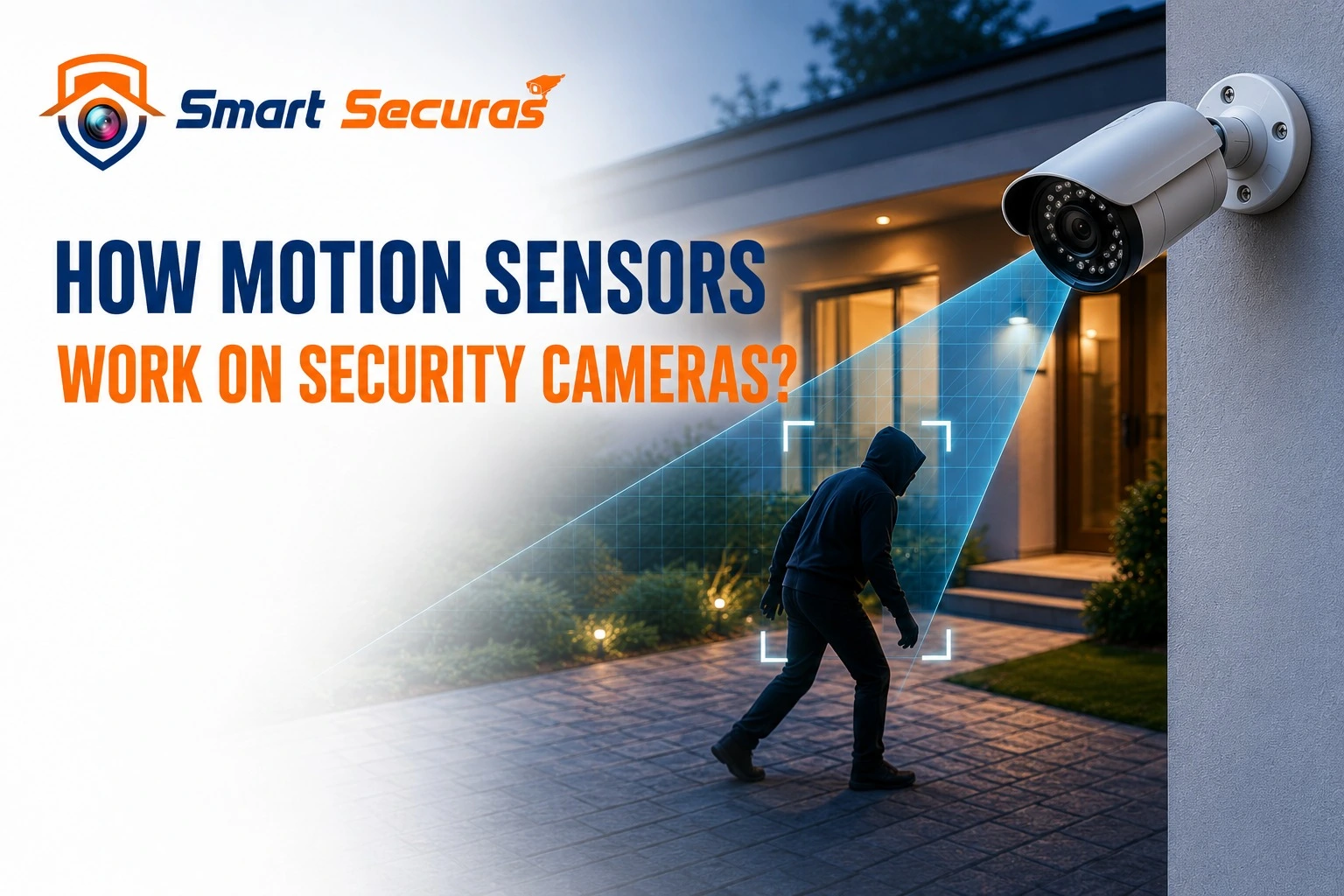
Motion sensors are one of the most useful features in modern CCTV cameras. They detect movement, trigger recordings, and send instant alerts to your phone. This guide explains how motion sensors work on security cameras and helps you choose the right camera for your property.
- Introduction
- What is a Motion Sensor on a Security Camera?
- What Makes a Security Camera Detect Motion?
- Motion Detection Zones — What Are They?
- Motion Detection Sensitivity — How to Set It Correctly
- What Happens When Motion is Detected?
- Benefits of Motion Sensors on Security Cameras
- Which Motion Detection Technology is Best for Your Property?
- Common Causes of False Motion Alerts — and How to Fix Them
- Motion Sensor CCTV Cameras Installation in Hyderabad
- Frequently Asked Questions
- Conclusion
Introduction
Have you ever wondered how your CCTV camera knows when to start recording?
The answer is motion sensors. Modern security cameras do not record everything all the time. Instead, they use motion sensors to detect movement and start recording only when something happens. This saves storage space and sends you instant alerts when something happens.
Knowing how motion sensors work helps you choose and set up the right camera for your property.
What is a Motion Sensor on a Security Camera?
A motion sensor is an electronic component built into a security camera.
Its job is to detect movement within the cameras field of view. When motion is detected, the camera triggers one or more actions:
- Starts recording
- Sends an alert to your phone
- Activates a siren or alarm
- Turns on a spotlight or floodlight
- Sends a notification to a security monitoring team
Without motion sensors, cameras would need to record continuously 24 hours a day. This uses a lot of storage and makes it hard to find specific incidents.
Motion detection solves both problems — cameras record only when needed, and you get instant notifications when something actually happens.
Most modern IP CCTV camera installation in Hyderabad includes motion detection as a standard feature. This means your cameras are always watching — but only recording and alerting when it matters.
What Makes a Security Camera Detect Motion?
There are several different technologies used in security camera motion sensors. Each works differently and suits different environments.
1. Pixel-Based Motion Detection (Video Motion Detection)
This is the most common type of motion detection used in CCTV cameras today.The camera continuously analyses each frame of video. When pixels in the image change — meaning something in the scene has moved — the camera triggers a recording and sends an alert.
How it works:
- The camera divides the image into a grid of zones
- It monitors each zone for pixel changes between frames
- When enough pixels change in a zone, the camera detects motion
- You can usually set the sensitivity level — higher sensitivity detects smaller movements
Advantage: Works on any camera with a processor. No extra hardware needed.
Disadvantage: Can cause false alarms. Wind moving tree branches, changes in lighting, insects flying near the lens, or shadows can all trigger pixel-based detection.
2. PIR (Passive Infrared) Motion Sensors
PIR sensors detect heat — specifically the infrared heat emitted by humans, animals, and vehicles.
Every warm object emits infrared radiation. A PIR sensor has a special lens that focuses this radiation onto a detector. When a warm object moves through the cameras field of view, the sensor detects the change in heat pattern and triggers the camera.
How it works:
- The PIR sensor detects infrared heat from warm objects
- When a person or vehicle moves through the detection zone, the heat pattern changes
- The sensor triggers the camera to start recording and send an alert
Advantage: Much more accurate than pixel-based detection. Reduces false alarms significantly because it only triggers on heat-emitting objects — not shadows, wind, or lighting changes.
Disadvantage: PIR sensors have a limited detection range and angle. They may not work well through glass windows.
3. AI-Based Motion Detection (Smart Motion Detection)
AI motion detection is the most advanced technology available in modern CCTV cameras.
Instead of just detecting pixel changes, AI cameras analyse the content of the video. They can identify what type of object is moving — a person, a vehicle, an animal, or something else.
How it works:
- The camera uses an onboard AI processor to analyse each frame
- It identifies specific objects — humans, cars, bikes, animals
- It only triggers an alert for the object types you have selected
- Irrelevant movement is ignored automatically
Example: You can set the camera to alert you only when a person enters your driveway — not when a cat or passing car triggers it.
Advantage: Extremely accurate. Almost no false alarms. You only get notified for what matters.
Disadvantage: Costs more than standard motion detection cameras. Requires more processing power.
4. Microwave Motion Sensors
Microwave sensors emit microwave signals and measure how the signals bounce back. When an object moves within the detection zone, the signal pattern changes and triggers the sensor.
Advantage: Can detect movement through walls and over larger distances than PIR sensors.
Disadvantage: More expensive. Can trigger false alarms from moving objects outside the intended detection zone.
Microwave sensors are mainly used in alarm systems. They are less common in standard CCTV cameras.
5. Dual Technology Motion Sensors
Some advanced security cameras combine two types of sensors — usually PIR and microwave — into one unit.
Both sensors must trigger simultaneously for an alert to be sent. This dramatically reduces false alarms because two independent detection methods must agree before the camera acts.
Advantage: Extremely low false alarm rate.
Disadvantage: Higher cost. Used mainly in commercial and industrial security systems.
Motion Detection Zones — What Are They?
Most modern CCTV cameras allow you to define specific detection zones within the cameras field of view.
You can draw a specific zone in the frame where you want motion to be detected.
Example:
- Set a zone at your front gate — only movement at the gate triggers an alert
- Exclude the road in the background — passing vehicles do not cause false alarms
- Set a zone inside your shops cash counter area — any movement triggers an immediate alert
Detection zones are configured through the cameras app or NVR settings. This reduces unnecessary alerts and focuses monitoring where it matters most.
Motion Detection Sensitivity — How to Set It Correctly
Most cameras allow you to adjust motion detection sensitivity on a scale — usually from low to high.
High sensitivity: Detects small movements — insects, leaves, minor lighting changes. More alerts but higher chance of false alarms.
Low sensitivity: Only detects significant movement — people, vehicles. Fewer alerts and more accurate notifications.
Best practice:
- Start at medium sensitivity
- Review which alerts are genuine and which are false alarms
- Adjust sensitivity up or down based on your environment
- Use AI detection or PIR sensors to reduce false alarms further
What Happens When Motion is Detected?
When a security camera detects motion, it can trigger several actions simultaneously:
1. Start recording
The camera begins saving video footage to the DVR, NVR, or cloud storage. Some cameras also record a few seconds before the motion event to capture what happened just before it was triggered.
2. Send a mobile alert
You receive a push notification on your phone with a snapshot or short video clip of the motion event. This allows you to see what is happening in real time.
3. Activate lights or sirens
Some cameras have built-in spotlights or sirens that activate when motion is detected. This deters intruders and alerts neighbours.
4. Trigger an alarm system
CCTV cameras can integrate with burglar alarm systems. When motion is detected, the alarm activates automatically.
5. Notify a monitoring centre
In monitored systems, the security company receives the alert, checks the footage, and contacts you if needed.
Benefits of Motion Sensors on Security Cameras
Motion sensors make CCTV systems smarter and more efficient. Here are the key benefits:
Saves storage space
Cameras only record when motion is detected. This reduces the amount of footage stored and extends how long your hard drive retains recordings.
Instant alerts
You are notified the moment something happens at your property — even when you are at work, travelling, or asleep.
Faster incident review
Instead of reviewing hours of empty footage, you only need to check motion-triggered clips. Finding a specific incident takes minutes instead of hours.
Deters intruders
Many cameras activate spotlights or sirens when motion is detected. The sudden light and sound deter most intruders immediately.
Reduces false alarms PIR and AI detection technologies significantly reduce unnecessary alerts compared to basic pixel-based detection.
CP Plus camera installation includes advanced motion detection that filters out false alarms caused by animals, shadows, and lighting changes — so you only get alerted when it truly matters.
Which Motion Detection Technology is Best for Your Property?
| Property Type | Recommended Technology |
|---|---|
| Small home or flat | Pixel-based or PIR |
| Large home or villa | PIR or AI detection |
| Office or retail shop | AI detection (Hikvision AcuSense / Dahua WizSense) |
| Warehouse or factory | PIR + AI with wide detection zones |
| Outdoor areas with trees | PIR or AI — avoid pixel-based only |
| School or hospital | AI detection for human detection only |
Common Causes of False Motion Alerts — and How to Fix Them
| Cause | Fix |
|---|---|
| Tree branches moving | Exclude that area using detection zones |
| Insects near lens | Clean the lens regularly |
| Lighting changes | Switch to PIR or AI detection |
| Passing vehicles | Use human-only detection in AI cameras |
| Shadows | Reduce sensitivity or switch to PIR |
Motion Sensor CCTV Camera Installation in Hyderabad
Smart Secures supplies and installs motion sensor CCTV cameras for homes, offices, factories, and commercial properties across Hyderabad.
We install cameras from CP Plus, Hikvision, and Dahua. All come with built-in motion detection, PIR sensors, and AI analytics. Every CCTV camera installation in Hyderabad includes mobile alert setup, detection zone configuration, and full customer training.
With 10+ years of experience and 8,800+ completed installations, Smart Secures is one of the most trusted names for CCTV camera installation in Hyderabad. Call us today for a free site visit.
Frequently Asked Questions
Conclusion
Motion sensors are one of the most important features in modern CCTV cameras. They make your security system smarter, more efficient, and more useful.
Knowing the difference between pixel-based detection, PIR sensors, and AI detection helps you pick the right camera. For most homes and businesses, AI-based motion detection gives the best results. It is accurate, reduces false alarms, and sends instant alerts when something happens.
Contact Smart Secures for motion detection CCTV installation in Hyderabad.
