
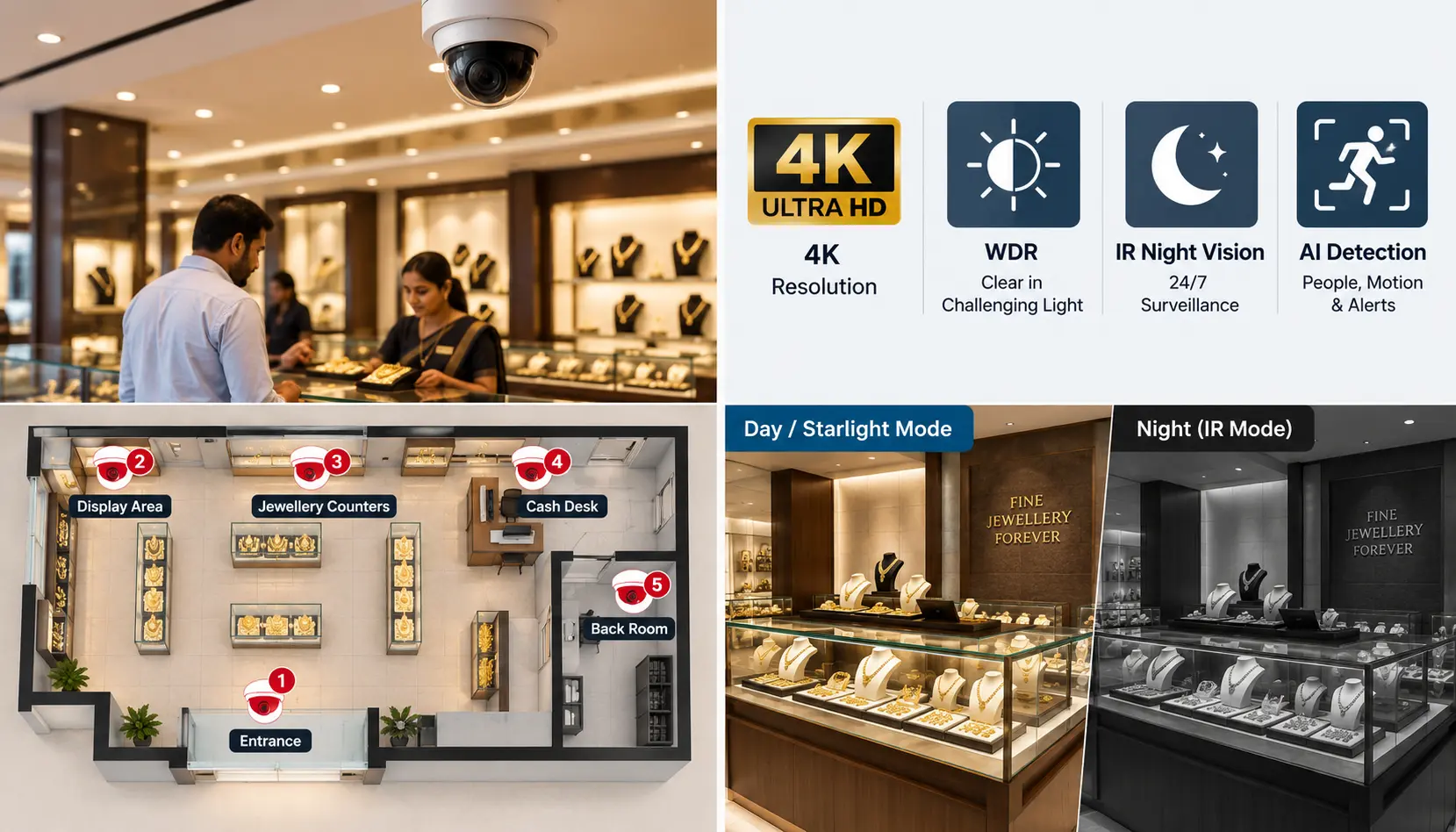
A jewellery shop can hold lakhs of rupees in gold and diamonds. All of it sits inside a few glass counters. That makes these shops a top target for theft, snatching, and staff pilferage. A basic camera with grainy footage will not stop a thief. It often can not even give police a clear image after the fact.
This guide covers the exact camera features a jewellery shop needs. Not generic CCTV tips, but specs picked for high-value counters, glass glare, and fast hands. By the end, you will know what to ask your installer for. You will also know where to place each camera and what it costs in Hyderabad.
Why a Standard CCTV Camera Falls Short in a Jewellery Shop
Most shops buy whatever camera package is cheapest. That is often fine for a clothing store or grocery shop. A jewellery showroom is different, for three reasons:
- Small, fast movements matter. A ring or chain can be palmed in under two seconds. Low frame rates and low resolution blur exactly the detail you need.
- Glass counters cause glare. Standard cameras wash out or darken the image when bright showroom lights bounce off glass display cases.
- The reward is high. So criminals plan around your cameras. Theft crews often scout a shop first. They look for blind spots, weak night vision, and cameras with no live alerts.
This is why showroom CCTV installation needs a different spec sheet than an office or warehouse. The features below tackle these exact risks.
Must-Have CCTV Camera Features for Jewellery Shops
1. High Resolution — 4K (8MP) Minimum
A 2MP camera can tell you that something happened. A 4K camera can tell you who did it. When you zoom into a frame to check a face or a hand, resolution is what keeps the image sharp, not a blur of pixels. For counters and entry points, treat 4K/8MP as the minimum, not an upgrade.
2. Optical Zoom on Counter Cameras
Resolution alone is not enough if the camera sits far from the counter. Real optical zoom (not digital zoom, which just stretches pixels) gets you a sharp, close crop of hands and faces at the display case. You do not need to move the camera closer to get that detail.
3. Wide Dynamic Range (WDR)
Jewellery shops are full of bright spotlights, mirrors, and glass. These are exactly the conditions that confuse ordinary camera sensors. WDR balances the bright and dark parts of one frame. That way, a customers face is not lost in glare from counter lighting or a sunlit entrance.
4. Starlight Sensors and Infrared Night Vision
Break-ins mostly happen after closing time, when the shop is dark. A Starlight sensor keeps producing clear color footage in very low light. It switches to infrared black-and-white only once it gets too dark for color. Both matter: color helps identify clothing and vehicles, while infrared keeps recording in full darkness.
5. AI-Based Motion and Human Detection
Older motion sensors trigger on anything that moves. A ceiling fan, a shadow, a moth near the lens — all of it sets off an alert. That floods your phone until you stop checking them. AI-based motion detection ignores that noise and flags only people. You get a real alert when someone is near the vault or counter after hours.
6. PoE Cabling Over Wi-Fi
A jewellery shop cannot afford a camera feed that drops out. Power over Ethernet (PoE) cameras carry power and data on one cable. There is no battery to run out and no Wi-Fi signal to lose. For any shop holding real inventory, PoE should be the default. Save Wi-Fi cameras for small gaps where cabling is not possible.
7. Remote Viewing From a Mobile App
You should be able to check your counters from home, from a supplier meeting, or on a trip. A good CCTV system sends a live feed and motion alerts straight to your phone. You do not have to rely on staff to notice something is wrong.
8. Tamper Alerts and Vandal-Resistant Housing
A camera only helps if it keeps pointing the right way and keeps recording. Tamper detection alerts you the moment a camera is covered, sprayed, or knocked out of position. That is often the first move in a planned robbery. A metal, vandal-resistant housing also makes the unit harder to disable during a break-in.
9. Reliable Storage: NVR/DVR Plus Cloud Backup
Local recording on an NVR or DVR is essential. But it is not enough on its own. If a thief steals or damages the recorder, your footage goes with it. Pair local storage with cloud backup, and your footage survives even if the recorder is taken.
Feature-by-Feature Quick Reference
| Feature | Why It Matters for a Jewellery Shop |
|---|---|
| 4K / 8MP resolution | Sharp enough to identify a face or item after zooming in |
| Optical zoom | Close, clear detail on counters without moving the camera |
| WDR | Prevents glare from glass counters and lighting from hiding faces |
| Starlight sensor + IR | Usable footage both after dark and during a blackout |
| AI human/motion detection | Real alerts instead of false alarms from shadows or fans |
| PoE cabling | No battery failures, no Wi-Fi drops on a continuous feed |
| Mobile app access | Check the shop remotely, any time |
| Tamper alerts | Flags attempts to disable or redirect the camera |
| Cloud + local storage | Footage survives even if the recorder is stolen |
Where to Place Cameras in a Jewellery Shop
Even the best camera fails if it points at the wrong spot. A typical jewellery shop needs coverage at these five points:
Entrance and exit. Wide-angle coverage of every person coming in or leaving, plus a face-height close-up camera.
Every display counter. One camera per counter line, angled to catch hands over the glass, not just the tops of customers heads.
Cash counter and billing desk. Covers cash handling and cuts down disputes over transactions.
Vault or back room. The restricted area where stock sits overnight.
Parking and street frontage. Captures vehicles and anyone loitering near the shop before or after hours.
CCTV Camera Setup Cost for Jewellery Shops in Hyderabad
Pricing depends on camera count, resolution, and whether you pick HD or IP (PoE) cameras. As a rough guide for a mid-sized jewellery showroom in Hyderabad:
- A 6–8 camera 4K IP system (entrance, counters, cash desk, back room) usually falls in the mid-range bracket in our 4-camera CCTV cost guide, scaled up for extra cameras and higher resolution.
- Add-ons to budget for: a cloud backup plan, AI analytics licensing, and an annual maintenance contract (AMC) for lens cleaning and firmware updates.
Want an exact number for your shop? Use the CCTV installation cost calculator or book a free site visit.
Choosing the Right Installer
Camera specs only matter if the install is done right. When you compare installers for a jewellery shop, check that they:
- Recommend cameras based on your actual counter layout, not a fixed package
- Use STQC-certified brands such as CP-Plus, Hikvision, or Dahua, not unbranded imports
- Offer an AMC for ongoing lens cleaning, firmware updates, and hard-disk health checks
- Can explain how backup and remote access will work before the install, not after
Smart Secures has handled CCTV installation for gold shops across Hyderabad. We can survey your shop layout and recommend a camera plan that fits it.
Frequently Asked Questions
Final Word
A jewellery shop cannot rely on the same camera package used for a general retail store. Resolution, WDR, AI detection, and reliable PoE cabling are not extras — they are the features that decide whether your footage actually helps if something goes wrong.
Ready to secure your showroom? Contact Smart Secures for a free site visit and a written quote tailored to your shops layout.
