
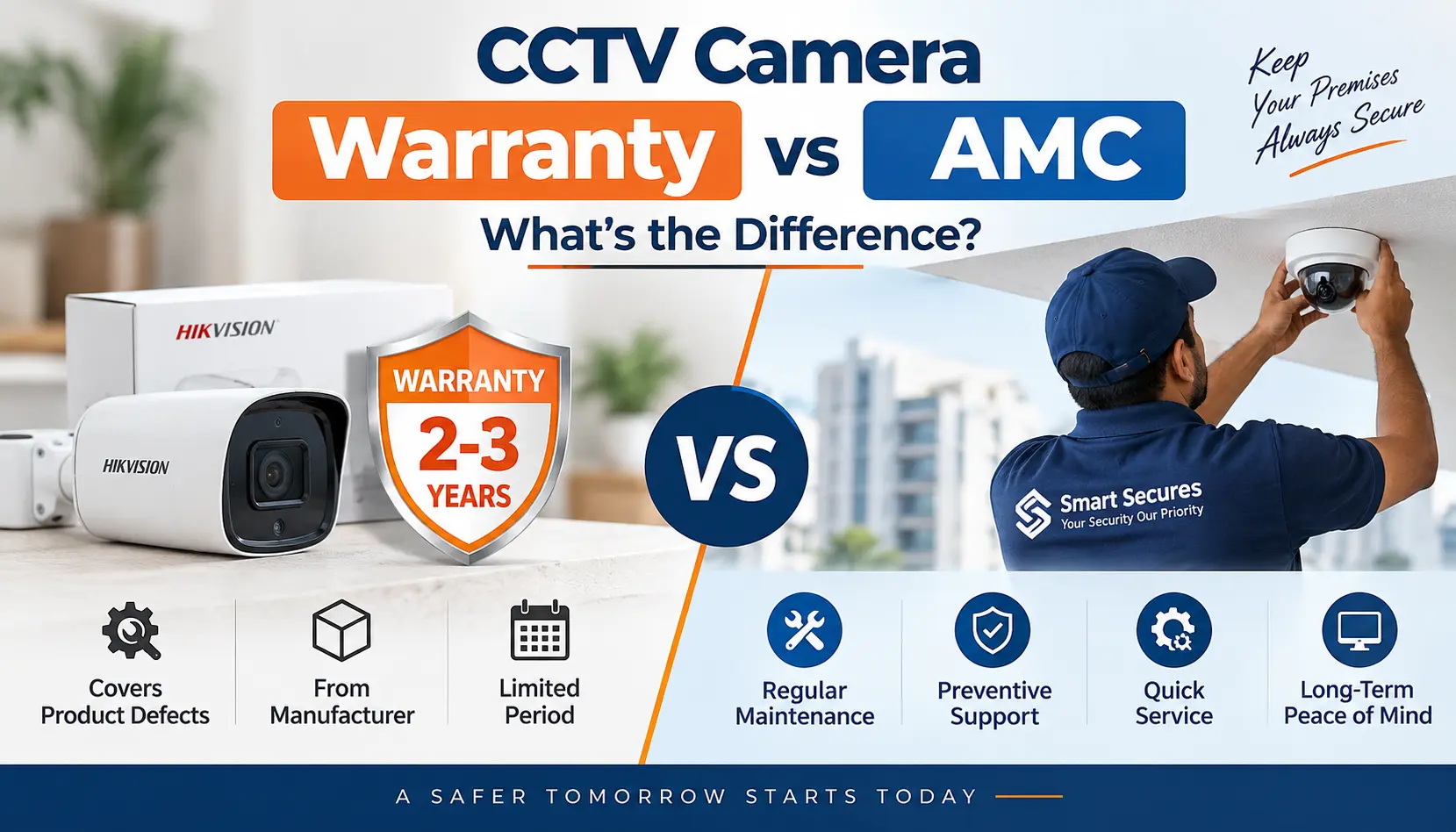
If your CCTV camera stops working, will it be fixed for free — or will you get a bill? The answer depends on whether the issue falls under warranty or AMC (Annual Maintenance Contract), and most CCTV owners only learn the difference after something breaks.
In short: a CCTV warranty is a manufacturers promise to repair or replace equipment that fails due to a defect, for a limited period. A CCTV AMC is a paid service agreement with an installer or service provider that covers ongoing maintenance, inspection, and support — usually for issues that warranty does not touch. They are not competing options; they cover different problems, and many systems benefit from both at different stages.
This guide breaks down what each one actually covers, where they overlap, where they do not, and how to decide what your system needs.
- What Is a CCTV Camera Warranty?
- What Is CCTV AMC?
- CCTV Warranty vs AMC — Key Difference
- Does CCTV Warranty Cover Maintenance?
- Does CCTV AMC Cover Camera Replacement?
- What Does a CCTV AMC Usually Include?
- What Does CCTV Warranty Usually Not Cover?
- CCTV Warranty vs AMC: Which One Do You Need?
- CCTV AMC Cost — What Affects the Price?
- Questions to Ask Before Buying CCTV AMC
- A Simple Example: Warranty and AMC in Action
- CCTV AMC and Warranty Support in Hyderabad
- FAQs
What Is a CCTV Camera Warranty?
A CCTV warranty is a commitment — usually from the manufacturer, sometimes backed by the seller or installer — to repair or replace a product if it fails due to a manufacturing defect within a specified period.
Warranty typically relates to the product itself, not to how it is installed or maintained. It generally applies to:
Manufacturing defects — a fault in materials or build quality, not damage caused by external factors.
An Hardware failure under normal operating conditions — for example, a camera sensor or DVR board failing without misuse.
Repair or replacement of the specific defective unit, as decided by the manufacturers policy
Warranty periods vary by manufacturer, product category, and sometimes by seller — some cameras carry a different warranty period than DVRs, NVRs, or accessories. There is no single standard period across the industry, so it is worth checking the specific terms for each product rather than assuming a fixed duration.
What warranty usually does not cover (again, this varies by manufacturer and terms):
- Physical damage from accidents, water ingress, or power surges
- Wear and tear from age or environmental exposure
- Damage caused by incorrect installation or unauthorised repair
- Cleaning, routine inspection, or configuration changes
- Labour charges for site visits, in many cases
A warranty protects you against product defects. It is not designed to keep a working system maintained over time — that is where AMC comes in.
What Is CCTV AMC?
An AMC (Annual Maintenance Contract) is a paid agreement between you and a service provider — often the installer — to maintain your CCTV system on a regular basis, for a defined period, usually a year.
Where warranty is reactive (it responds when a covered part fails), AMC is largely preventive. A typical AMC is built around:
- Preventive maintenance — scheduled visits to inspect cameras, clean lenses and housings, and check connections before problems occur
- Breakdown support — troubleshooting and fixing issues that come up between scheduled visits
- Inspection of cameras, DVR/NVR, cabling, and power supply
- Cleaning of camera lenses, housings, and vents
- Troubleshooting for connectivity, recording, or display issues
- Configuration support — adjusting settings, motion zones, recording schedules, or remote-viewing access
- Scheduled service visits, at a frequency defined in the contract
An AMC exists to keep a working system working well — catching small issues (a loose cable, a dusty lens, a failing hard disk) before they turn into downtime. It does not automatically mean every spare part or replacement is free; that depends entirely on what is written into the specific agreement.
CCTV Warranty vs AMC — Key Difference
| Feature | CCTV Warranty | CCTV AMC |
|---|---|---|
| Main Purpose | Protect against manufacturing defects | Keep the system maintained and running smoothly |
| Provided By | Manufacturer (sometimes seller/installer) | Installer or third-party service provider |
| Cost | Usually included with the product | Paid separately, typically annually |
| Duration | Fixed period set by manufacturer; varies by product | Contract period, commonly renewed yearly |
| Nature | Reactive — responds to a defect | Mostly preventive, with breakdown support |
| Preventive Maintenance | Not typically included | Core part of the service |
| Repair Support | Limited to defect-related repairs | Broader troubleshooting and repair, per contract |
| Manufacturing Defects | Covered, within terms | Not the AMCs role — this stays with warranty |
| Replacement | Defective unit only, per manufacturer policy | Depends on contract; not automatic |
| Service Visits | Rare, only for defect claims | Scheduled, as per agreement |
| Labour Charges | Often excluded or limited | Usually included, depending on contract |
Exact inclusions on both sides depend on the specific warranty terms and the AMC agreement you sign — this table reflects common industry patterns, not a universal rule.
Does CCTV Warranty Cover Maintenance?
No, not in the way most people expect. Warranty covers repair or replacement when a product fails due to a genuine defect — it is not designed to provide routine upkeep.
It helps to separate three different things that often get confused:
Step-by-Step Process
Warranty coverage — applies only when a product is faulty, and only within its defined terms
Routine/preventive maintenance — cleaning, inspection, and adjustment done regularly to prevent problems, which is an AMC function, not a warranty one
Service support — troubleshooting and configuration help, which may be charged separately if you do not have an AMC
So if a camera lens gets dusty, a cable comes loose, or a hard disk starts showing early warning signs, that is a maintenance issue — not automatically a warranty claim, even if the product is still within its warranty period.
Does CCTV AMC Cover Camera Replacement?
It depends entirely on the contract, but here is how it usually breaks down:
Labour and service charges — almost always included in an AMC, since that is the core of what you are paying for
Spare parts and camera replacement — only included in a "comprehensive" AMC; a "non-comprehensive" AMC typically covers labour and service but bills spare parts separately
DVR/NVR replacement — same logic: covered only if the contract specifically includes hardware replacement
Power supply issues — often included as a maintenance item, but full replacement may be a separate cost
Hard disk failure — a common failure point in CCTV systems; whether replacement is covered depends heavily on the AMC type
Cable faults — usually covered as a maintenance/repair item since it is a common, low-cost fix
Before assuming your AMC covers replacement, check whether it is comprehensive or non-comprehensive, and get the exact inclusions in writing.
What Does a CCTV AMC Usually Include?
A typical AMC scope includes:
- Scheduled preventive maintenance visits (frequency defined in the contract)
- Cleaning of camera lenses, housings, and vents
- Checking camera angles, focus, and night-vision performance
- Inspecting DVR/NVR health, storage, and recording quality
- Checking cabling, connectors, and power supply
- Software and firmware checks where applicable
- Remote-viewing and access configuration support
- Priority troubleshooting for breakdowns during the contract period
- A defined response time for service requests
What Does CCTV Warranty Usually Not Cover?
Common exclusions — again, these vary by manufacturer and product, so treat this as a general pattern rather than a fixed rule:
- Physical damage from accidents, tampering, or unauthorised handling
- Damage from water, dust, or extreme weather beyond the products rated protection
- Power surge or electrical damage, unless specifically covered
- Issues caused by third-party or unauthorised repair attempts
- Normal wear and tear over time
- Labour or site-visit charges, in many cases
- Routine cleaning, inspection, or configuration work
CCTV Warranty vs AMC: Which One Do You Need?
There is no single right answer — it depends on where your system is in its lifecycle and how critical it is to your operations. Many businesses use both, just at different stages.
Warranty may be important when:
- The system is newly installed and still within the manufacturers warranty period
- You are primarily concerned about hardware defects rather than upkeep
- The installation is small and does not yet justify a paid maintenance contract
AMC may be useful when:
- The manufacturers warranty has expired
- The system supports something business-critical — a shop, warehouse, hospital, or office — where downtime is costly
- You have multiple cameras that need regular inspection and cleaning
- You want predictable, scheduled support rather than reactive fixes
- Minimising downtime matters more than minimising cost
For many homes, small shops, and growing businesses, a practical approach is: rely on warranty while it lasts, then move to an AMC once it expires — or take an AMC alongside warranty if the system is critical from day one.
CCTV AMC Cost — What Affects the Price?
CCTV AMC pricing is not fixed — it depends on several factors:
- Number of cameras in the system
- Type of cameras (analog, HD, IP) and their complexity
- DVR/NVR specifications and storage capacity
- Location and accessibility of the installation
- Age of the system — older systems often need more frequent attention
- Preventive maintenance frequency — quarterly visits cost more than annual ones
- Scope of coverage — whether spare parts and replacement are included (comprehensive vs non-comprehensive)
- Labour coverage included in the contract
- Guaranteed response time for breakdowns
- Overall contract terms and duration
Because these factors vary so much from one installation to another, it is best to get a written quote based on your specific system rather than relying on a generic figure.
Questions to Ask Before Buying CCTV AMC
- 1. Are spare parts included, or billed separately?
- 2. Is camera replacement included if a unit fails?
- 3. Is DVR/NVR repair covered under the contract?
- 4. Is hard disk replacement included?
- 5. Are service visits unlimited, or capped at a certain number?
- 6. Is preventive maintenance included, and how often?
- 7. Is labour included, or charged per visit?
- 8. What is the guaranteed response time for breakdowns?
- 9. Are cables and connectors covered?
- 10. What happens to support and any pending issues after the contract expires?
A Simple Example: Warranty and AMC in Action
Say a business installs 20 cameras with a DVR and dedicated hard disk. Over the next two years:
- A camera develops a manufacturing defect in month 3 → this is a warranty matter, handled by the manufacturer under the applicable terms.
- A camera lens becomes dusty, blurring the footage → this is a maintenance issue, addressed during a scheduled AMC visit.
- A cable connector comes loose after a year → typically an AMC repair item, not a warranty claim.
- The DVR develops a fault after the warranty period ends → without an AMC, this repair would likely be chargeable; with an AMC, it may be covered depending on the contract.
- The hard disk starts failing after 18 months of continuous recording → warranty may or may not apply depending on the disks own warranty terms, while an AMC with preventive maintenance is more likely to catch early warning signs during a routine check.
- The system needs a general inspection before a busy season → this is a preventive AMC activity, not something warranty is designed to provide.
This is exactly why relying on warranty alone often leaves gaps — and why many businesses eventually add an AMC once the initial coverage period ends.
CCTV AMC and Warranty Support in Hyderabad
If you are running CCTV cameras for a home, shop, office, school, hospital, warehouse, or society in Hyderabad, understanding this difference matters before your existing warranty runs out. Smart Secures provides CCTV installation Services, supply, and AMC services in Hyderabad, helping system owners plan ahead — whether that means tracking manufacturer warranty timelines or setting up a maintenance contract once coverage ends, so cameras keep recording reliably rather than being noticed only when something stops working.
