
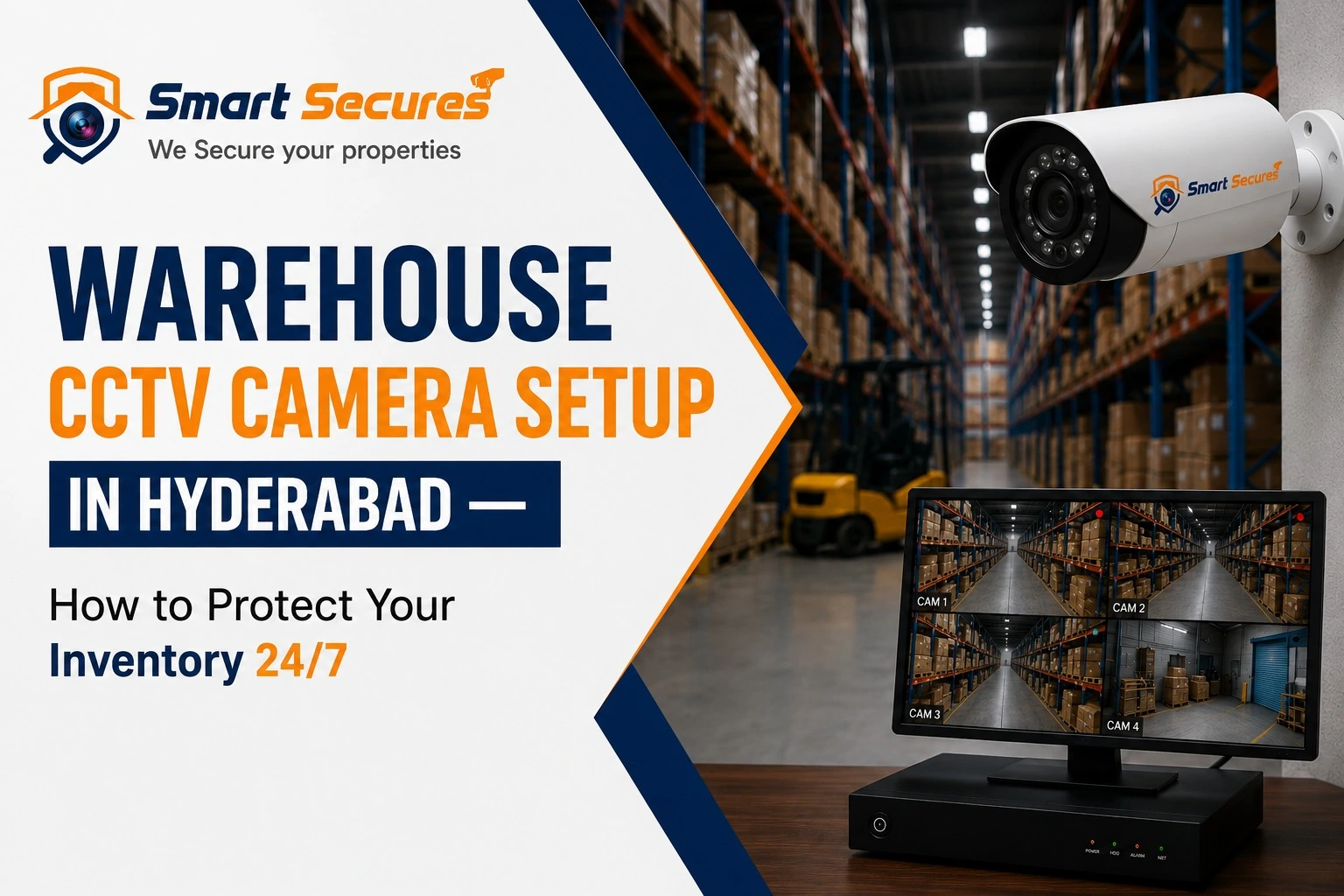
Most warehouses in Hyderabad need 8 to 20 cameras covering loading docks, aisles, entry gates and perimeter. Use IP67-rated cameras for dusty environments, IP cameras on a central NVR for remote access and zoom clarity, and retain footage for 15 to 90 days to cover stock audit periods. Smart Secures provides a free site visit with no obligation.
A warehouse holds your working capital in physical form. Racks of stock, pallets at the loading dock, and high-value goods moving in and out all day make it one of the most theft-prone properties a business can own.
Stock can disappear in small quantities over months before anyone notices the shortfall — and by then, there is no proof of how it happened.
A well-planned CCTV setup changes that. It records every movement in and out, detects internal and external theft, and gives you footage you can actually use when a discrepancy shows up in the inventory count.
A warehouse CCTV system performs best when every camera is planned for your building's layout, storage areas and daily operations. Our CCTV installation services in Hyderabad include a free site survey, camera placement planning, professional installation, mobile app configuration, and complete system testing. Whether you manage a small warehouse or a large distribution centre, we design a surveillance solution that delivers reliable security and long-term performance.
This guide explains how to set up warehouse CCTV in Hyderabad that genuinely protects your stock around the clock.
Where Warehouse Stock Actually Goes Missing
Before placing a single camera, it helps to know where losses happen. In most warehouses, shrinkage comes from a handful of predictable points:
Loading and unloading docks
The busiest and highest-risk zone in any warehouse — goods change hands quickly, multiple people are present simultaneously, and the pace makes discrepancies easy to miss or create.
Receiving area
Where incoming stock is counted — or miscounted — before it is shelved. Short deliveries that are not caught here become inventory losses with no clear cause later.
High-value storage
Small, expensive items are the easiest to pocket. High-value zones need dedicated camera coverage at every access point, not just general floor cameras.
Dispatch and packing
Where orders are assembled and items can be added or removed. Cameras over packing tables capture quantities at the exact moment goods are packed — protecting you against both outgoing tampering and incoming short-delivery claims.
Entry gates and back doors
Including doors that are supposed to stay shut. Every entry and exit point needs a camera — the ones that should stay locked are often the ones that do not.
Your camera plan should cover these five zones first. Everything else is secondary. A site walk confirms the exact camera positions for your specific warehouse layout.
How to Plan Camera Placement
Camera placement in a warehouse is not about covering the most area — it is about covering the right positions with the right angle. A wide camera pointed at the wrong zone is wasted hardware. Here is the placement logic for each zone:
Loading docks
Mount cameras to capture the full dock, the vehicle, the goods being moved and the people handling them. A clear view of the truck bed and the dock floor together is essential — this is where most disputes get settled. Use 4MP cameras here; 2MP is not enough to read a label or identify a face at dock distance.
Aisles and racks
Cameras down the length of each aisle let you track who accessed which rack and when. In tall warehouses, mount high enough to see over the racking but angle the camera downward to keep the floor in view. One camera per aisle end, plus one at the mid-point for long aisles.
Entry and exit points
Every door — including emergency exits, roller shutters and delivery hatches — should have a camera facing it. The goal is a complete log of everyone entering and leaving, at every point, at all times.
Receiving and dispatch
Position cameras directly above the counting and packing tables so quantities are visible in the footage. This protects you in both directions: incoming short deliveries and outgoing order tampering.
Perimeter and yard
For the outside of the building and any open yard or vehicle parking area, wide-angle cameras along the boundary detect intruders before they reach the stock. Colour night-vision cameras are essential here — standard IR cameras produce unusable grey footage at night.
High-value storage zones
Dedicated cameras at every access point to high-value bays. Motion alerts during off-hours give you a real-time notification the moment someone enters a zone that should be empty.
IP vs HD Cameras for Warehouses
This is the most common decision warehouse owners face. The right answer depends on warehouse size, the distance cameras need to cover and whether remote access matters to you.
HD cameras (DVR-based)
Affordable and reliable for indoor coverage and smaller warehouses. They give clear footage for everyday monitoring at a lower upfront cost. HD cameras with a DVR system are a practical choice for single-floor warehouses under 5,000 sq ft with straightforward camera positions.
IP cameras (NVR-based)
The stronger choice for larger warehouses. IP cameras deliver higher resolution, let you zoom into footage without losing clarity, support remote viewing from your phone and record to one central NVR. For a property where you need to read a label or identify a face at distance, the extra resolution pays off. IP camera packages are available in bundles that cover full warehouse layouts.
For most mid-to-large warehouses in Hyderabad, IP camera installation is the better long-term investment because of the resolution, scalability and remote-access benefits.
Building Conditions to Plan For
Warehouses are tough on equipment. Choosing hardware that cannot handle the environment leads to lens failures, corrupted recordings and cameras that stop working precisely when you need them.
1. Dust and heat
IP67-rated cameras are sealed against dust and moisture and built for harsh storage environments. For any warehouse with airborne dust, powder or chemical residue, IP67 is the minimum rating — not an upgrade.
2. Low light
Colour night-vision cameras keep recording clearly after hours — when most warehouse break-ins happen. Standard IR cameras produce grey, unusable footage in the kind of low light found in unlit warehouse yards and perimeter areas.
3. Large open spans
A single PTZ camera can cover a wide open floor or yard by panning and zooming to follow movement — covering what four fixed cameras would need to cover. For warehouses with large open bays, a PTZ is a cost-effective anchor camera.
Storage: How Many Days of Footage?
The retention question matters most in warehousing, because inventory discrepancies often surface days or weeks after the fact. If footage only goes back a few days, the evidence is already gone by the time anyone investigates.
Plan retention around four factors:
- Number of cameras and total data generated per day
- Recording resolution (4MP generates more data than 2MP)
- Continuous vs motion-triggered recording mode
- The number of days you need to cover for audit purposes
A central NVR with the right hard-disk capacity can hold 15 to 90 days or more. For warehouses with regular stock audits, lean toward 60–90 days so footage always covers the full audit period.
💡 Storage tip: 16 cameras at 4MP recording continuously need 6–8 TB for 30 days. Use surveillance-grade hard disks — consumer desktop drives fail within months under continuous write load.
Round-the-Clock Monitoring Features
1. Mobile remote viewing
Check any camera from your phone, from anywhere. An IP-based system streams live footage to a mobile app so you can monitor every shift and every zone without being on site.
2. Instant alerts
Get a notification the moment a gate or shutter opens outside working hours. Motion alerts for off-hour activity mean you know about an incident as it happens — not the next morning.
3. Motion detection zones
Flag movement in zones that should be empty overnight. Set specific camera zones — high-value bays, emergency exits — to trigger alerts on any movement outside set hours.
These features turn a passive recording system into an active deterrent. A warehouse owner who gets a 2 AM alert on their phone can respond before the loss happens, not after.
What Warehouse CCTV Setup Costs in Hyderabad (2026)
The CCTV installation cost in Hyderabad depends on several factors, including the warehouse size, number of cameras, recording duration, camera resolution and installation complexity. Understanding these factors before purchasing helps you choose a surveillance system that matches both your security needs and your budget.
Warehouse CCTV pricing depends on five main factors:
- Number of cameras required (typically 8–20 for a standard warehouse)
- IP vs HD cameras choice — IP cameras cost more per unit but deliver better results for large spaces
- Cable run length — long runs across large warehouses add to installation time and cost
- Number of access points requiring individual cameras
- NVR storage capacity and the retention period required
A proper quote always follows a site visit because aisle length, ceiling height and dock count significantly affect the camera count and cable requirements. Every installation from Smart Secures includes cameras, a recorder, a hard disk, cabling, installation and a GST bill — no hidden charges.
Industrial CCTV installation in Hyderabad for warehouses starts from Rs.30,000 for smaller single-floor units and scales with floor area and camera count. Call us or WhatsApp for a free site visit and written quote.
Frequently Asked Questions
Conclusion
The difference between a warehouse that loses stock quietly and one that does not usually comes down to three things: coverage at the dock, footage retention long enough to matter, and a system that alerts you in real time when something happens.
Smart Secures designs every warehouse CCTV system after a full site walk — using IP67-rated cameras for tough conditions, proper NVR storage sized for your retention needs, and genuine equipment from authorised brands with full warranty support.
For industrial CCTV installation in Hyderabad, call us on +91 93461 33102 or WhatsApp us today. We visit your warehouse, map every zone and give you a clear written quote — no obligation.
Also read: CCTV Installation for Factories in Hyderabad — costs, cameras and site planning.
