
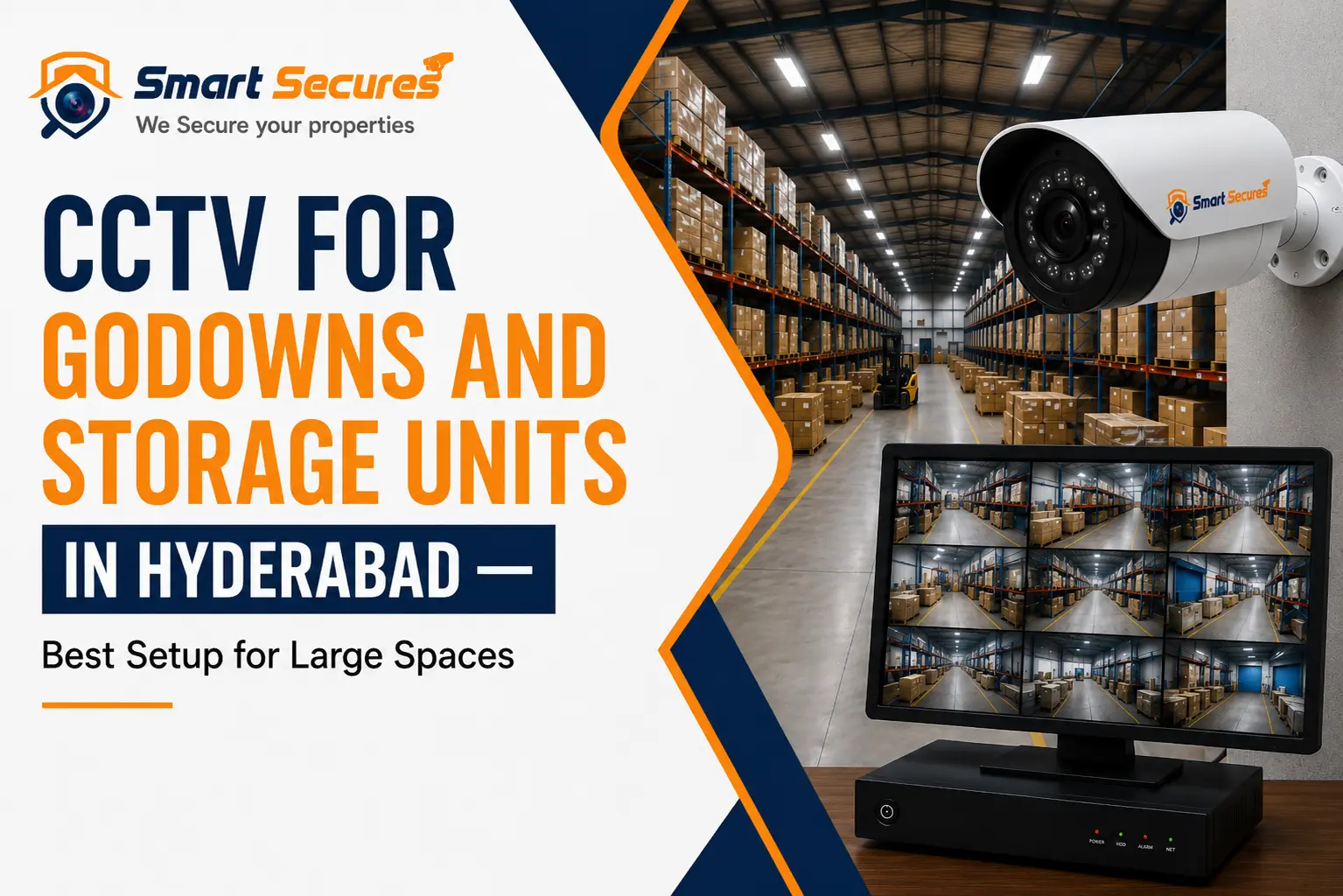
A godown presents a security problem that most properties do not: a lot of valuable stock spread across a large, often sparsely-staffed open space, sometimes on the edge of the city where wired internet and reliable power cannot be taken for granted.
The instinct is to bolt a camera on every wall — but thats expensive, hard to wire, and usually leaves the big open middle of the space poorly covered anyway.
The smarter approach is to cover large areas efficiently: fewer, better-placed cameras that see across open spans, hardware that survives dust and weather, and a setup that works even where infrastructure is thin. This guide walks through the best CCTV setup for godowns and storage units in Hyderabad.
What Makes Godowns Different From Other Industrial Sites
Before choosing cameras, it is worth being clear about the specific challenges a godown throws up:
Large open spans
wide floors and tall stacks that fixed cameras struggle to cover without leaving gaps.
High stock value in a low-traffic space
fewer people around means an intruder can work undisturbed.
Loading-bay activity
vehicles and goods moving in and out is the main risk window.
Tough conditions
dust, heat, and sometimes rain exposure on open or semi-open sides.
Thin infrastructure
remote godowns may lack broadband or stable power.
These constraints shape every decision below. You can see how a full godown deployment is structured on the godown CCTV solutions page.
Covering Large Open Spaces Efficiently
The single biggest mistake in godown surveillance is treating a 10,000 sq ft open space like a series of small rooms. You do not need a camera every few metres, you need cameras chosen and placed to see across the space.
Use long-range PTZ for the open floor
A pan-tilt-zoom camera mounted high can sweep the entire floor and zoom in on any activity, covering an area that would otherwise need three or four fixed cameras. For wide, open godown interiors and yards, one well-placed PTZ unit does more than a wall full of fixed cameras.
Cover the corridors, not every square metre
In a racked godown, position cameras down the length of each aisle. You are tracking who accessed which race. Full-floorr coverage of space adds little.
Prioritise the loading bay
This is where the stock actually leaves. One to two cameras per bay, capturing the vehicle, the goods, and the people handling them, protects you against the most common form of loss.
Lock down every entry point
Each door and shutter, including ones meant to stay closed, needs a camera facing it, so you have a complete log of everyone entering and leaving.
Watch the perimeter
For the building exterior and any open compound, wide-area cameras along the boundary detect intruders before they reach the stock.
Choosing Cameras for Godown Conditions
The right hardware depends heavily on where your godown is and what infrastructure it has.
| Situation | Best camera choice | Why |
|---|---|---|
| Standard godown with power and internet | IP67 IP cameras on a central NVR | High resolution, remote access, sealed against dust and heat |
| Very large open floor or yard | Long-range PTZ | One unit covers what several fixed cameras cannot |
| Remote site, unreliable power | Solar CCTV cameras | Run on solar power, unaffected by power cuts |
| No broadband available | SIM-based 4G/5G cameras | Use mobile data instead of wired internet |
| Smaller indoor godown on a budget | HD cameras with DVR | Clear footage at a lower upfront cost |
For most godowns with basic infrastructure, IP cameras give the resolution and remote viewing you want. But the real advantage of a planned setup shows up on remote or off-grid sites, solar and SIM-based cameras let you secure a godown that conventional wired systems cannot easily reach.
Round-the-Clock Protection Features
Because godowns are often unstaffed for long stretches, the monitoring features matter as much as the cameras:
Instant phone alerts
the moment a gate or shutter opens outside working hours.
Mobile remote viewing
so you can check any camera from anywhere.
Night vision
for clear footage after dark, when most break-ins happen.
Motion detection
to flag movement in zones that should be empty overnight.
Together, these turn an unattended godown into a monitored one, where you know about an incident as it happens, not when you next visit.
Storage and Retention
Stock discrepancies in a godown often surface during a periodic count, days or weeks after the goods actually went missing. If your footage does not reach back that far, the evidence is gone. Plan retention around camera count, resolution, recording mode, and the days you want to keep most godowns should aim for 15 to 90 days or more on a central NVR sized to match.
What Does a Godown Setup Cost
Pricing depends on the number of cameras, the camera type (solar and SIM-based units cost more than standard wired cameras), cable runs across a large floor, the number of access points, and storage. Because godown sizes and infrastructure vary so widely, an accurate quote always follows a site visit. Every package should include cameras, a recorder, a hard disk, cabling, installation, and a GST bill with no hidden charges. To compare starting configurations, the IP camera packages are a useful reference point.
Frequently Asked Questions
Secure Your Large Space the Smart Way
Good godown surveillance is not about the most cameras, it is about covering large open spaces efficiently, with hardware that suits your sites power and internet, and retention long enough to catch losses that surface weeks later. Smart Secures plans every godown after a full site walk, with tough cameras, solar and SIM-based options for remote sites, and honest, all-inclusive quotes.
Book a free godown site visit to get a coverage plan and a clear quotation for your storage space.
