
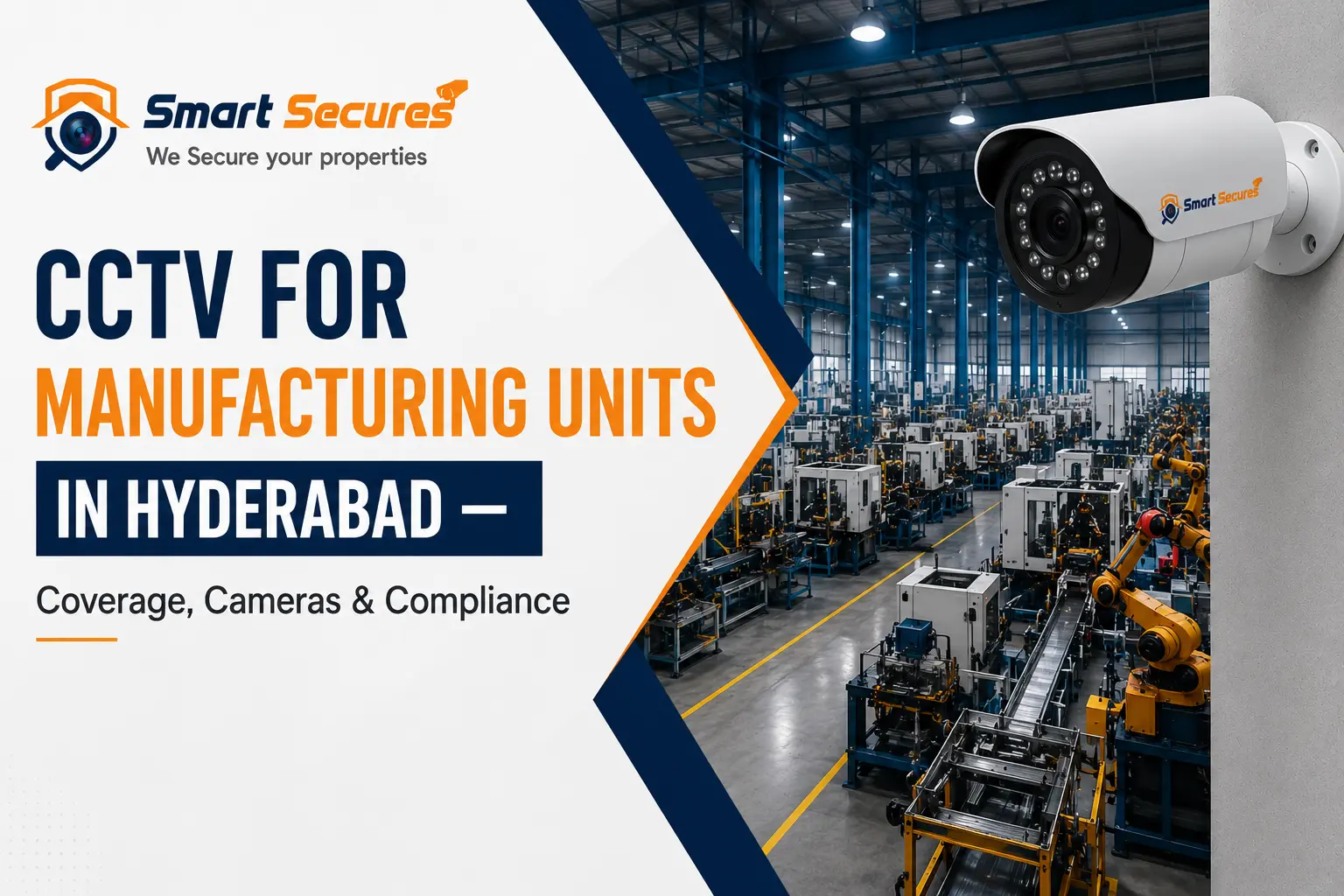
A manufacturing unit in Hyderabad needs IP67-rated cameras for dusty production floors, PTZ cameras for wide assembly areas, thermal cameras for equipment monitoring, and spark-safe cameras for hazardous zones. A typical unit uses 8 to 64 cameras depending on floor area, with footage retained for 15 to 90 days. Installation starts from Rs.40,000. Smart Secures provides a free zone-by-zone site survey with no obligation.
A manufacturing unit never stops moving. Raw materials come in. Finished goods go out. Machines run through every shift. That constant motion is exactly why CCTV matters here more than it does in a quiet office.
A camera on the production floor is not just about theft. It covers safety compliance, process accountability and quality disputes. A clear video record when something goes wrong protects the business, the workers and the management.
This guide covers what a manufacturing unit in Hyderabad needs from a CCTV system — which zones must be covered, which cameras survive a production environment, how many cameras a unit actually needs, how much footage to retain, and the compliance points that are easy to miss. It sits alongside our wider industrial CCTV installation in Hyderabad service, which covers factories, warehouses and plants as well.
- What CCTV Does for a Manufacturing Unit
- The Zones That Must Be Covered
- Camera Types for a Production Environment
- How Many Cameras Does a Manufacturing Unit Need?
- Choosing Reliable Equipment
- Storage and Retention
- Compliance and Safety Considerations
- Manufacturing Unit CCTV vs Factory CCTV
- Keeping the System Dependable
- CCTV Installation Cost for Manufacturing Units in Hyderabad
- Manufacturing Areas We Cover in Hyderabad
- Frequently Asked Questions
- Conclusion
What CCTV Does for a Manufacturing Unit
A manufacturing surveillance system earns its place by doing several jobs simultaneously — none of which a single camera position can handle alone. This is why zone-by-zone planning is essential, not optional.
Safety monitoring
Confirms that workers follow safety procedures around machinery and that every incident — near-miss or actual — is recorded. This footage is essential during insurance reviews and HSE inspections.
Process accountability
Tracks material handling from raw input through to finished output. When a batch goes missing or arrives short, the footage shows exactly what happened at each handover point.
Asset protection
Guards tools, raw materials and finished stock against theft — both by outsiders and by insiders who know the facility layout well enough to avoid obvious cameras.
Quality and dispute resolution
Provides footage when a defect or damage claim needs investigating. Being able to show when and where a defect entered the process eliminates guesswork and protects against false claims.
Audit and compliance records
Keeps a ready video trail for ISO audits, factory inspections and certifications. Auditors increasingly expect CCTV records as part of a site visit.
The Zones That Must Be Covered
Every manufacturing unit has the same set of critical zones regardless of what it produces. The camera specifications differ by zone — getting the right camera in the right position is what makes the difference between footage you can act on and footage that just fills a hard drive.
Production lines
The heart of the unit. Cameras over each line monitor machine operation, worker movement and material flow. Mount high with a wide field of view so the full line stays in frame — a camera that only covers part of a line is not useful for process accountability.
Raw material and finished goods stores
Both ends of the process hold high value. Door-facing cameras log everyone who enters or exits. Floor cameras track stock movement and position. Most internal theft in manufacturing happens at storage access points, not on the production floor itself. If your stores are a separate building, our warehouse CCTV setup guide covers rack-level and dock coverage in more detail.
Quality control stations
Footage here settles disputes over when and where a defect appeared in the process. Without it, a customer claim about a defective batch is impossible to investigate with certainty.
Entry gates and loading bays
Every vehicle and person entering or leaving should be recorded — for security and for matching dispatch records. The loading bay is where most unit theft actually happens. A 4MP camera at the threshold capturing goods crossing the line is essential.
High-risk and utility zones
Areas with heat, sparks, chemicals or pressure need specialised cameras — standard cameras are a safety risk here. Boundary walls need perimeter coverage with colour night-vision cameras to detect intruders early.
Parking and vehicle areas
Employee vehicles, delivery trucks and raw material carriers all move through the site. Number-plate capture at entry and exit creates a complete vehicle log — useful for security and for verifying delivery records.
Camera Types for a Production Environment
Manufacturing floors are demanding — dust, heat, vibration and sometimes hazardous conditions. The hardware has to match the environment, not just the resolution requirement. Using a standard office dome camera on a production floor leads to lens failures and corrupted footage within months.
| Camera type | Best used for | Key specification |
|---|---|---|
| IP67 outdoor / industrial cameras | Production floors, gates, bays, dusty areas | Dust and water sealed — rated for continuous industrial use |
| Long-range PTZ cameras | Wide assembly floors and large open yards | One PTZ covers what four fixed cameras would cover |
| IP cameras on a central NVR | Whole-site coverage with remote access | High resolution, scalable, supports live mobile monitoring |
| Thermal / heat-detection cameras | Equipment monitoring and fault detection | Detects overheating before visible signs appear |
| Spark-safe / explosion-proof cameras | Chemical, fuel and gas zones | Certified safe for hazardous atmospheres — mandatory in these areas |
| Colour night-vision cameras | Boundary walls and dark exterior areas | Full-colour footage in low light — far better than standard IR |
For sharp footage on indoor production floors, 4MP IP camera installation on a central NVR gives the best combination of image quality, remote access and storage efficiency. HD cameras with DVR recording are an economical option for smaller units with limited zones.
For long boundary walls, remote gates or under-construction sections where running power is impractical, solar CCTV cameras remove the need for a cable run across the site.
How Many Cameras Does a Manufacturing Unit Need?
Camera count is driven by production lines, store rooms, gates and hazardous zones rather than by floor area alone. These figures give a realistic planning range before a site survey:
| Unit size | Typical camera count | What it covers |
|---|---|---|
| Small single-shed unit One production line |
8–12 cameras | One line, one store, main gate, boundary, loading point |
| Mid-size unit Two to three lines |
16–32 cameras | Each line, raw and finished stores, QC station, gate, bays, perimeter |
| Large multi-shed plant Four or more lines |
32–64+ cameras | All of the above plus PTZ on open yards, thermal on critical equipment, spark-safe in hazardous zones, parking and number-plate capture |
The right number always comes from walking the floor and mapping blind spots against your actual process flow — which is exactly what the free site survey is for.
Choosing Reliable Equipment
In a high-use manufacturing environment, camera reliability matters as much as resolution. Cameras run continuously — 24 hours a day, every day — in tough conditions. The units have to keep performing for years without the lens fogging, the housing cracking or the sensor degrading.
Sticking to established surveillance brands with proper warranty support avoids the false economy of cheap units that fail within months. Working with an authorised dealer ensures genuine products, full warranty coverage and dependable after-sales service.
Smart Secures is an authorised dealer for Hikvision, CP Plus and Dahua — all STQC-certified brands suitable for industrial environments. We also supply Prama, Securus and Uniarch; you can compare every brand we deal with before deciding. Every installation uses genuine equipment with full manufacturer warranty.
Storage and Retention
Manufacturing disputes surface well after the event. A quality claim arrives three weeks after the batch was dispatched. A workplace incident leads to an insurance review six weeks later. Your retention period decides whether that footage still exists when it is needed.
Plan storage from day one — it is far harder to increase retention after the system is installed than to size it correctly upfront.
Retention depends on four things: camera count, resolution, recording mode (continuous vs motion-triggered) and the number of days you need to keep. A correctly sized NVR holds 15 to 90 days across all cameras. Units that undergo certification audits or insurance reviews should plan for the longer end of that range.
💡 Storage tip: 16 cameras at 4MP recording continuously need 6–8 TB for 30 days. Use surveillance-grade hard disks in a dedicated NVR — consumer desktop drives are not rated for continuous write cycles and will fail in a manufacturing environment within months.
Compliance and Safety Considerations
CCTV in a manufacturing unit sits at the intersection of security and workplace regulation. Getting these points right from the start avoids legal exposure and makes the system audit-ready from day one.
Visible signage
Notices informing staff and visitors that the premises are monitored are a legal requirement, not optional. Place them at every entrance and within the production area.
Privacy boundaries
Cameras must not be placed in areas where workers reasonably expect privacy — changing rooms, restrooms and break rooms are off limits regardless of security concerns.
Restricted NVR access
Recorded footage must be stored behind strong credentials with access limited to authorised personnel only. Document who has access and review it regularly.
Hazardous-zone camera ratings
Only spark-safe, explosion-proof cameras in chemical, fuel or gas areas. Using standard cameras in these zones is a safety and liability risk — it is not just an equipment issue.
Audit alignment
Retention period and zone coverage should meet any standards specific to your sector or certification body. Discuss audit requirements with your installer before the system is designed.
Manufacturing Unit CCTV vs Factory CCTV — What Actually Changes
The two terms get used interchangeably, but the coverage plan is not identical. The core zones overlap — gates, floor, stores, boundary — while the emphasis shifts:
- Quality control coverage. A manufacturing unit needs cameras over QC and inspection stations so a defect can be traced to a point in the process. A general factory plan often skips this.
- Process accountability. Manufacturing footage is used to reconstruct material handover between stages, not just to catch theft.
- Thermal monitoring. Continuous-run machinery makes heat-detection cameras a preventive maintenance tool, not just a fire measure.
- Audit documentation. Certification bodies and insurers ask for retention and access-control records, so the system has to be designed around an audit trail from day one.
If your site is closer to heavy assembly or fabrication than to line-based production, our factory CCTV installation guide is the better starting point.
Keeping the System Dependable
A camera that is not recording is worse than no camera — it gives a false sense of security. In a dusty, hot, vibration-heavy manufacturing environment, lenses fog, connectors loosen and hard disks wear faster than in any other setting.
Regular servicing keeps every camera working when you actually need the footage. A scheduled CCTV AMC plan covers lens cleaning, cable and connector checks, NVR health verification and storage capacity monitoring. The most common failure pattern in manufacturing CCTV is discovering that the NVR stopped recording weeks earlier — only when an incident makes that footage necessary.
Smart Secures provides an Annual Maintenance Contract for manufacturing units across Hyderabad, with a full system health report after every visit so you always know every camera is live and recording.
CCTV Installation Cost for Manufacturing Units in Hyderabad (2026)
Installation cost depends on unit size, number of production lines, camera types required for each zone and the storage retention period needed. Key factors that affect the final figure:
- Number of production lines and total floor area
- Whether hazardous zones require spark-safe cameras (higher unit cost)
- Whether thermal cameras are needed for equipment monitoring
- Number of entry gates, loading bays and boundary wall length
- NVR storage capacity and retention period (15, 30, 60 or 90 days)
- Whether remote monitoring and mobile app access is required
Industrial CCTV installation in Hyderabad for manufacturing units starts from Rs.40,000 for smaller single-shed units and scales based on floor area and camera types required. For an indicative range before your survey, review our IP camera packages and HD camera packages — a site survey is still the only reliable way to get an accurate figure for your specific layout.
Smart Secures provides a free site survey for manufacturing units across Hyderabad — written quote per zone, no hidden charges, no obligation before the survey.
Manufacturing Areas We Cover in Hyderabad
Most of the manufacturing and processing units we secure sit in Hyderabad’s industrial belts. We install and maintain systems across Balanagar, Bachupally, Kukatpally and the surrounding corridors — including Jeedimetla, Patancheru, Medchal, Nacharam, Uppal, Kattedan and Shamshabad.
Same-day response is available in most of these areas. You can check availability for your locality on our CCTV service areas page.
Frequently Asked Questions
Conclusion
A manufacturing CCTV system works when it fits your actual floor — your production lines, stores, gates, loading bays and risk zones. No fixed package works for every unit, because every unit is different in layout, scale and compliance requirement.
Smart Secures plans every system after a full site walk. We use cameras built for tough production conditions, supply genuine equipment from authorised brands and provide full warranty support on every CCTV installation in Hyderabad.
For industrial CCTV installation in Hyderabad, call us on +91 93461 33102, message us on WhatsApp, or book a free site survey. We will visit your manufacturing unit, map every zone and give you a clear written quote — no obligation.
Also read
- CCTV Installation for Factories in Hyderabad — costs, camera types and site planning.
- Warehouse CCTV Camera Setup in Hyderabad — dock, aisle and rack-level coverage.
- CCTV for Godowns and Storage Units in Hyderabad — best setup for large open spaces.
